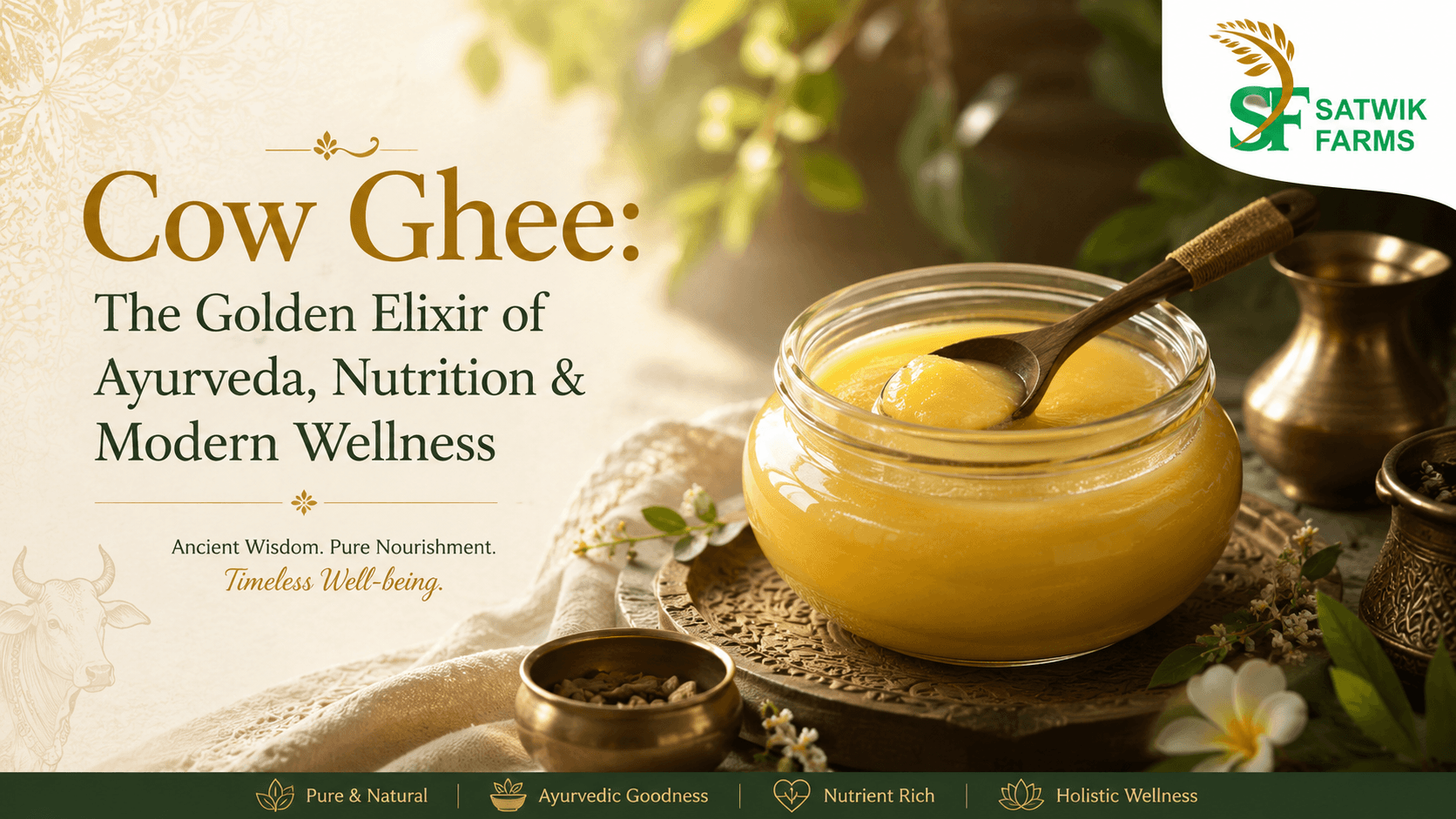
For thousands of years, cow ghee has held a sacred place in Indian kitchens, Ayurvedic healing traditions, and Satwik living. Revered as "liquid gold," pure cow ghee is far more than a cooking fat — it is nourishment, medicine, digestive support, and a symbol of purity in traditional Indian culture.
Today, modern science is beginning to validate many of those traditional beliefs. From gut health and fat-soluble vitamins to high-heat cooking stability and metabolic effects, cow ghee is being rediscovered globally as a functional food. Research highlights its content of beneficial fatty acids such as butyric acid and conjugated linoleic acid (CLA), along with vitamins A, E and K.
This guide brings together Ayurvedic wisdom, Satwik philosophy and modern nutritional science to explore what cow ghee really is — and how to use it well.
What Is Cow Ghee?
Cow ghee is clarified butter traditionally prepared by simmering butter made from cow milk until the water evaporates and milk solids separate. What remains is a pure, golden butterfat with a rich aroma and a distinctive nutty flavour.
Unlike refined oils, authentic cow ghee is minimally processed and traditionally prepared with slow heating. In Ayurveda — especially when made from cultured butter using the classical Bilona method — ghee is regarded as one of the most Sattvic and nourishing foods.
From a nutritional standpoint, ghee is a stable fat rich in fat-soluble vitamins and bioactive fatty acids. Because the milk solids are removed during preparation, ghee contains very little lactose and casein compared to butter — which is why many people who are sensitive to dairy can tolerate it more easily.
Ghee in Ayurveda: The "Ghrita" Tradition
In Ayurveda, ghee is known as Ghrita. Classical Ayurvedic texts describe it as:
- Medhya — supports intellect and memory
- Rasayana — rejuvenating
- Agni deepaka — supports digestive fire
- Ojas vardhaka — enhances vitality
- Vata-Pitta balancing
Ayurveda uses ghee extensively as:
- A carrier in herbal preparations (medicated ghritas)
- A key element in Panchakarma therapies
- A medium for Nasya (nasal oleation)
- A base for traditional eye treatments
- Daily support for digestion and brain nourishment
Reviews of Ayurvedic literature have catalogued hundreds of references to the therapeutic value of ghee across digestion, cognition, immunity, skin health and overall nourishment.
In Satwik tradition, cow ghee is associated with clarity, calmness, positivity and spiritual energy — a food of consciousness as much as of the body.
Nutritional Composition
Approximate values per 1 tablespoon (≈14 g) of cow ghee:
| Nutrient | Approximate Amount |
|---|---|
| Calories | 120–125 kcal |
| Total Fat | 14 g |
| Saturated Fat | 8–9 g |
| Monounsaturated Fat | ~4 g |
| Polyunsaturated Fat | ~0.5 g |
| Vitamin A | 10–13% DV |
| Vitamin E | small amount |
| Vitamin K | small amount |
| Butyric Acid | present |
| CLA | present |
Grass-fed cow ghee tends to carry higher concentrations of beneficial fatty acids such as CLA and fat-soluble vitamins.
A Closer Look at Ghee's Fats
One of the biggest misconceptions about ghee is that all saturated fat is the same — or that it is uniformly harmful. Modern nutritional science increasingly recognises that different fats behave differently in the body, and that food matrices (not just isolated nutrients) matter.
Saturated fat
Cow ghee's saturated fats provide stable energy, support cellular membranes and assist hormone production. Moderation remains important — particularly for those with raised cholesterol or excess calorie intake — but the older blanket view of saturated fat is being revisited.
Butyric acid
Ghee naturally contains butyric acid, a short-chain fatty acid associated with:
- Support for the gut lining
- Reduced intestinal inflammation
- Colon health
- Overall digestive comfort
Butyrate is also produced naturally by a healthy gut microbiome — so dietary butyric acid is, in a sense, a familiar fuel for the gut.
Conjugated linoleic acid (CLA)
CLA has been studied for its potential role in:
- Metabolic support
- Fat metabolism
- Immune balance
- Anti-inflammatory action
Small amounts of omega fatty acids
Ghee carries small quantities of omega fatty acids that may modestly contribute to heart, cellular and inflammation balance — though it should not be considered a primary omega-3 source.
Why Cow Ghee Is Considered Satwik
In Satwik nutrition, food is judged not only by macros and micros, but by its energetic quality. Satwik foods are pure, fresh, natural, lightly processed, digestible and mind-calming.
Cow ghee is traditionally viewed as:
- A consciousness-enhancing food
- A carrier of prana (life energy)
- Supportive for meditation and clarity
- Nourishing without dullness
Unlike heavily refined industrial oils, traditionally made ghee is slow-cooked, stable and deeply nourishing. In many Indian households, a small spoon of warm ghee on freshly cooked food is a quiet symbol of abundance, wellness and digestive balance.
Health Benefits of Cow Ghee
1. May support digestion
Ayurveda considers ghee one of the best foods for improving Agni (digestive fire). Practical benefits may include:
- Better lubrication of the intestines
- Reduced dryness
- Easier bowel movement
- Better absorption of nutrients
The butyric acid content may further support intestinal cells and overall gut health.
2. Enhances absorption of fat-soluble nutrients
Many nutrients require fat to be absorbed well. Ghee can help carry:
- Vitamin A
- Vitamin D
- Vitamin E
- Vitamin K
- Carotenoids from vegetables
Adding a small spoon of ghee to dals, sabzis and steamed vegetables may meaningfully improve their nutritional payoff.
3. Excellent for high-heat cooking
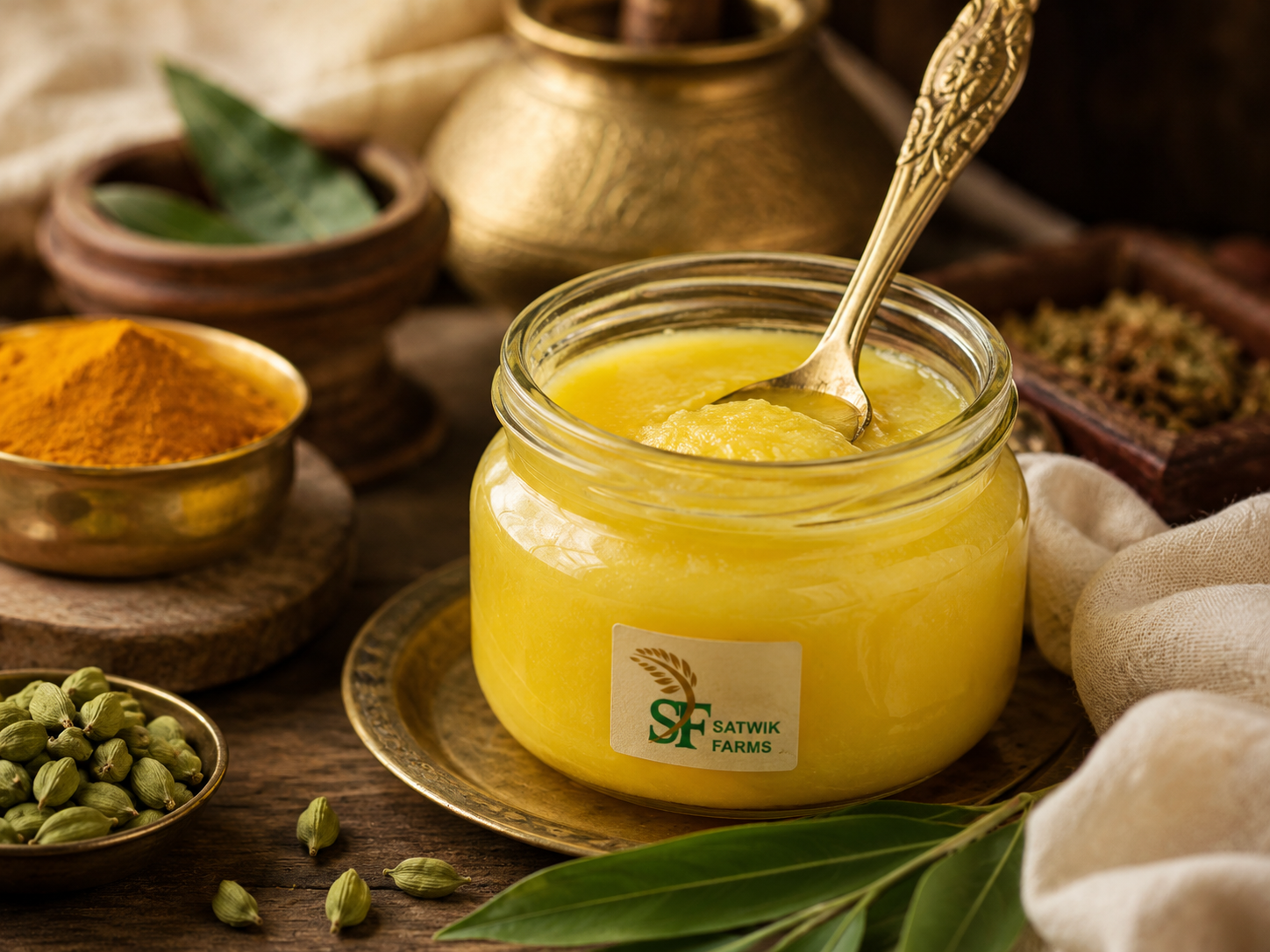
Ghee has a high smoke point of around 250°C (485°F) — substantially higher than most refined seed oils. This makes it:
- More stable under heat
- Less prone to oxidation than many vegetable oils
- A suitable choice for tadka, sautéing, roasting and shallow frying
There is also emerging evidence that ghee may produce fewer harmful oxidation by-products during high-heat cooking than some industrial vegetable oils.
4. May support brain and nervous system function
Ayurveda describes ghee as Medhya — supportive of intellect and cognition. Healthy fats matter for brain cell membranes, nerve function, hormone production and overall mental stability. Many traditional Ayurvedic preparations specifically use ghee as a delivery medium for herbs that support the nervous system.
5. Skin nourishment
Ghee has long been used both internally and externally for skin care. It may support:
- Skin moisture
- Relief of dryness
- Delivery of fat-soluble antioxidants
- A healthy skin barrier
Ayurveda also formulates dedicated medicated ghees for various skin therapies.
6. Steady energy and satiety
Ghee provides concentrated, slow-burning energy. Compared to refined-carb-heavy meals, fats like ghee digest more slowly — which may help with:
- Sustained energy
- Fewer hunger spikes
- A more satisfying meal
7. Joint and tissue lubrication
Ayurveda associates ghee with snigdha guna — the unctuous, lubricating quality — and recommends it traditionally for dryness, weakness, tissue depletion and the stiffness that often comes with age. It is particularly valued for balancing aggravated Vata.
Cow Ghee and Modern Science
Research on dairy fats has evolved significantly. Older dietary models broadly classified saturated fats as harmful, but newer evidence paints a more nuanced picture — and active research now focuses on:
- Butyrate and short-chain fatty acids
- CLA
- The whole-food dairy matrix (not just isolated fats)
- Heat stability of cooking fats
- Interactions with the gut microbiome
A 2024 review comparing Ayurveda and modern science noted that Ayurvedic literature focuses strongly on cognition, digestion and overall nourishment, while modern research has concentrated on cardiovascular and metabolic markers. The two traditions ask different questions of the same food — and bringing them together opens genuinely interesting research possibilities.
Cow Ghee vs Refined Oil
Traditional wellness systems consistently favour minimally processed fats over chemically refined oils. The practical case for ghee:
- Naturally stable
- No hydrogenation
- High smoke point
- Rich, recognisable flavour
- Beneficial fatty acids (butyrate, CLA)
- Minimal processing
By contrast, many refined vegetable oils undergo high-temperature processing, oxidise more easily, and can carry residues from industrial extraction. That said, balance still matters — a healthy diet relies on diverse whole foods and mindful use of all fats, including ghee.
Best Ways to Use Cow Ghee
In cooking
- Tadka (tempering)
- Roasting vegetables
- Stir-frying
- Khichdi
- A small smear on warm rotis or rice
Traditional ways
- A spoon in warm milk
- Combined with herbs as part of an Ayurvedic preparation
- Light digestive support
Satwik occasions
- Temple food
- Fasting meals
- Meditation-supportive diets
- Simple, nourishing everyday meals
Best time to consume ghee
Ayurveda generally recommends moderate ghee intake with lunch, on warm freshly cooked food, and slightly more freely during dry or cold seasons. Warm food with ghee is considered far easier to digest than cold or greasy food.
Bilona Ghee vs Commercial Ghee
| Aspect | Traditional Bilona Ghee | Commercial Cream Ghee |
|---|---|---|
| Source | Cultured curd, churned to butter | Often directly from cream |
| Method | Slow-heated in small batches | Faster, larger-scale production |
| Flavour | Deeper, traditional, aromatic | Lighter, more uniform |
| Ayurvedic view | Preferred | Acceptable, but less revered |
For Ayurveda and Satwik nutrition, Bilona ghee is widely considered the gold standard.
How Much Ghee Should You Eat?
Moderation is essential. A sensible daily amount depends on:
- Activity level
- Digestive capacity
- Total calorie intake
- Existing health conditions
Excessive intake of any fat — including ghee — can contribute to extra calories, weight gain and elevated cholesterol in susceptible individuals. For most healthy adults, a few teaspoons across the day as part of cooked food is a reasonable starting point.
Precautions
Ghee is gentle for most people, but please respect the cautions:
- Hyperlipidemia / cardiovascular conditions: if you have raised cholesterol or diagnosed heart disease, treat ghee as a flavour and cooking choice in moderation — not a health remedy — and follow your doctor's dietary advice.
- Obesity or excess calorie intake: ghee is calorie-dense; small amounts add up quickly.
- Severe digestive weakness: introduce slowly; in cases of poor digestion, large amounts can sit heavy.
- Dairy allergy: while ghee is very low in lactose and casein, those with a true dairy protein allergy should consult their doctor before regular use.
- Children: small culinary amounts on food are generally beneficial — there is no need to give therapeutic doses without guidance.
- Pregnancy & breastfeeding: culinary use is traditionally encouraged in Ayurveda; therapeutic doses should be discussed with a qualified practitioner.
A supportive food, not a medical treatment. If you are managing a medical condition, please continue any prescribed treatment and consult your healthcare provider before changing the role of ghee in your diet.
How to Identify Pure Cow Ghee
Signs of quality
- Rich, recognisable aroma
- Slightly grainy texture once set
- Golden-yellow colour
- No artificial fragrance
- Clean ingredient list — just ghee, nothing else
Prefer
- Grass-fed sources
- Traditional preparation (ideally Bilona)
- Small-batch production
- No additives, no preservatives
Cow Ghee in Satwik Living
In Satwik philosophy, food should nourish the body, mind, emotions and consciousness — not just the body. Cow ghee represents simplicity, nourishment, sacredness, digestibility and traditional wisdom.
A spoon of warm ghee on something as humble as khichdi, millet roti or freshly cooked rice is, in this view, deeply balancing and grounding — a small daily act that joins flavour, health and tradition in one gesture.
Final Thoughts
Cow ghee is one of the oldest functional foods recognised by traditional Indian wellness systems. Revered in Ayurveda and increasingly studied by modern nutrition science, it offers a unique combination of culinary stability, nourishment, digestibility and traditional therapeutic value.
Its richness in fat-soluble vitamins, butyric acid, CLA and stable fats makes it a worthwhile part of a balanced diet when used mindfully. Ayurveda regards ghee not merely as a fat, but as a carrier of vitality, digestion, mental clarity and rejuvenation.
In a world dominated by ultra-processed foods and industrial oils, traditional cow ghee stands as a reminder that ancient food wisdom often carried profound nutritional intelligence. Sourced properly and used in moderation, pure cow ghee is a nourishing part of a wholesome, Satwik lifestyle rooted in simplicity, balance and conscious eating.
This article is for general educational purposes only and is not a substitute for professional medical advice, diagnosis or treatment. If you have an existing medical condition (especially raised cholesterol, heart disease or a true dairy allergy), are taking any medication, or are pregnant or breastfeeding, please consult your healthcare provider before making significant changes to your diet.
Related Reading
If you found this helpful, you may also like: