Our hands are often called the "outer brain" of the body. According to Yoga and Ayurveda, the fingers represent the five fundamental elements (Panch Mahabhutas) that make up the human body and the universe. The ancient science of Hasta Mudra (hand gestures) uses specific finger positions to influence the flow of Prana (life force), helping restore physical, mental and energetic balance.
The word Mudra comes from the Sanskrit root meaning seal, gesture or energy lock. By joining certain fingers together, subtle energy circuits are created that may help harmonise bodily functions.
Hasta Mudras have been practised for thousands of years in Yoga, Ayurveda, meditation and spiritual traditions. Modern studies also suggest that mudra practice — especially combined with breathing and meditation — may improve autonomic nervous system balance, reduce stress, enhance breathing efficiency and support overall well-being when practised regularly.
Important: Hasta Mudras are complementary wellness practices. They should not replace medical diagnosis or treatment for serious illnesses.
Panch Mahabhutas and the Fingers
| Finger | Element | Functions |
|---|---|---|
| Thumb | Fire (Agni) | Digestion, metabolism, immunity |
| Index finger | Air (Vayu) | Movement, nervous system |
| Middle finger | Space (Akasha) | Expansion, hearing, consciousness |
| Ring finger | Earth (Prithvi) | Strength, tissues, bones |
| Little finger | Water (Jala) | Fluids, skin, blood, lubrication |
According to Ayurveda, disease occurs when these elements become imbalanced. Mudras are believed to help restore this elemental harmony.
How Mudras Work
Ancient yogic texts explain that the fingers act like switches controlling energy flow. Modern physiology suggests several possible mechanisms:
- Gentle finger pressure stimulates sensory nerves.
- Practice influences parasympathetic (relaxation) nervous activity.
- It improves breathing awareness.
- It enhances mindfulness.
- It reduces stress hormones.
Stress reduction alone can positively influence immunity, digestion, blood pressure and sleep.
Practical Guidelines
- Practise on an empty stomach, or 1–2 hours after meals.
- Sit comfortably with the spine erect and shoulders relaxed.
- Breathe slowly through the nose.
- Practise with both hands.
- Hold each mudra 15–30 minutes daily — this can be divided into three sessions of 10 minutes each.
Vayu Mudra — The Key Mudra for Vata Balance
How to perform
- Fold the index finger.
- Place the thumb gently over the bent index finger.
- Keep the remaining fingers straight.
Ayurvedic benefits
Vayu Mudra is traditionally used to reduce excess Vata Dosha, which governs movement in the body. It may help ease:
- Joint pain and arthritis discomfort
- Gas and bloating
- Neck pain
- Tremors
- Sciatica and cervical spondylosis discomfort
- Anxiety and restlessness
Duration: 15–20 minutes, twice daily.
Linga Mudra — The Traditional Mudra for Cough and Cold
How to perform
- Interlock the fingers of both hands.
- Keep one thumb upright.
- Wrap the opposite thumb around it.
Benefits
Linga Mudra is said to increase internal warmth and Kapha-reducing energy. It is traditionally used in:
- Productive cough
- Cold and sinus congestion
- Mild asthma and bronchitis (alongside prescribed treatment — never in place of an inhaler)
- Low body temperature
Precautions
Avoid prolonged practice if you have fever, dehydration, high body heat or hyperacidity.
Duration: 10–15 minutes.
Prana Mudra — The Mudra of Vital Energy
How to perform: touch the tips of the thumb, ring finger and little finger together.
Benefits: traditionally used to improve vitality, reduce fatigue, support immunity, ease eye strain and enhance recovery.
Duration: 20–30 minutes daily.
Gyan Mudra — Mental Calmness
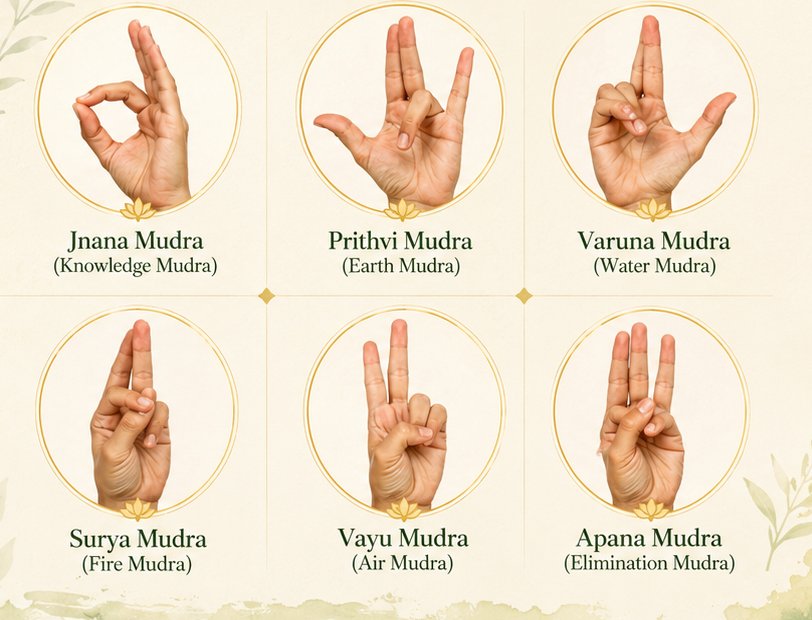
How to perform: touch the tip of the index finger to the thumb; keep the other fingers relaxed.
Benefits: supports concentration and meditation, may help with insomnia, stress, mental fatigue and stress-related blood-pressure elevation, and can be a calming companion practice alongside professional care for low mood.
More Mudras at a Glance
- Apana Mudra (middle + ring finger to thumb) — supports elimination; traditionally used for constipation, piles, urinary health and gentle detoxification.
- Prithvi Mudra (ring finger to thumb) — balances the Earth element; traditionally used for weakness, low body weight, hair health, bone-strength support and tissue nourishment.
- Varun Mudra (little finger to thumb) — balances the Water element; traditionally used for dry skin, dehydration, dry cough, joint lubrication and skin glow.
- Surya Mudra (ring finger folded to the base of the thumb) — reduces Earth and increases Fire; traditionally used to support weight management, metabolism and sluggish digestion, and may assist fatty-liver management alongside diet and exercise. Avoid prolonged use if underweight.
- Shunya Mudra (middle finger folded, pressed by thumb) — traditionally used for ear discomfort, vertigo, motion sickness and, in some individuals, ringing in the ears.
Common Concerns and Traditionally Suggested Mudras
| Concern | Traditionally suggested mudra |
|---|---|
| Vata disorders | Vayu Mudra |
| Arthritis discomfort | Vayu + Prana |
| Gas and bloating | Vayu |
| Dry cough | Varun |
| Productive cough | Linga |
| Cold | Linga |
| Asthma (supportive only) | Linga + Prana |
| Diabetes (supportive only) | Prana + Gyan |
| Stress-related hypertension | Gyan |
| Stress | Gyan |
| Constipation | Apana |
| Weak immunity | Prana |
| Fatigue | Prana |
| Dry skin | Varun |
| Weight management | Surya |
These pairings reflect traditional Ayurvedic associations, not medical prescriptions. For conditions like diabetes, hypertension or asthma, mudras are at most a calming complement — continue your prescribed medicines and monitoring exactly as directed by your doctor.
The Ayurveda and Satwik Perspective
From the Satwik viewpoint, mudras work best when combined with:
- Fresh seasonal fruits and vegetables
- Sprouted legumes and whole grains
- Cow's milk (if suitable)
- Adequate hydration
- Meditation and pranayama
- Positive thoughts
- Early sleep and early waking
Foods that aggravate Vata — excessively dry, cold, processed or irregular meals — are best minimised while practising Vayu Mudra.
Scientific Evidence
Although research is still developing, several studies suggest that yogic hand mudras and meditative practices may:
- Improve heart-rate variability (an indicator of autonomic balance)
- Reduce perceived stress and anxiety
- Improve respiratory function when combined with breathing exercises
- Enhance attention and mental relaxation
- Support quality of life in chronic disease management
Most available evidence comes from small clinical trials or observational studies, so larger, high-quality studies are still needed before disease-specific claims can be confirmed.
Precautions
- Mudras should not replace prescribed medicines.
- Stop if you experience pain or significant discomfort in the hands.
- Consult your healthcare provider for chronic illnesses, severe respiratory symptoms, or uncontrolled diabetes or hypertension.
- Consistency is more important than intensity.
A Daily 30-Minute Mudra Routine
| Time | Mudra |
|---|---|
| 10 minutes | Gyan Mudra |
| 10 minutes | Vayu Mudra (or Linga Mudra during cough/cold) |
| 10 minutes | Prana Mudra |
References
- Hatha Yoga Pradipika
- Gheranda Samhita
- Charaka Samhita (Ayurvedic principles of dosha balance)
- Sushruta Samhita
- Jerath R, et al. Physiology of long pranayamic breathing. Medical Hypotheses.
- Brown RP, Gerbarg PL. Sudarshan Kriya Yogic Breathing in the treatment of stress and anxiety. Journal of Alternative and Complementary Medicine.
- Innes KE, Selfe TK. Reviews on yoga interventions for chronic disease management.
Conclusion
Hasta Mudras are simple, accessible and cost-free practices that can complement a healthy lifestyle. From an Ayurvedic perspective, they help restore balance among the five elements and the three doshas. Regular practice — along with a Satwik diet, yoga, pranayama, adequate sleep and appropriate medical care when needed — may support better respiratory health, calmer nerves, improved digestion and overall well-being.
The greatest benefits typically come from practising daily with patience and consistency, rather than expecting immediate results.
This article is for general educational purposes only and is not a substitute for professional medical advice, diagnosis or treatment. If you have an existing medical condition (especially diabetes, high blood pressure, asthma or another chronic respiratory condition), or are taking any medication, or are pregnant, please consult your healthcare provider before relying on complementary practices.
Related Reading
Continue exploring mindful living with Satwik Farms:
- Kundalini Jagaran (Part 1): What Is Kundalini Shakti? The Seven Chakras & Satwik Foundations
- Kundalini Jagaran (Part 2): Chakra Meditation with Mudras & Bija Mantras
- Kundalini Jagaran (Part 3): A Complete Daily Meditation Routine
- Grounding & Earthing: Ayurveda and the Science of Natural Healing
- Walking for Health: Benefits, Best Time & the Ayurvedic View