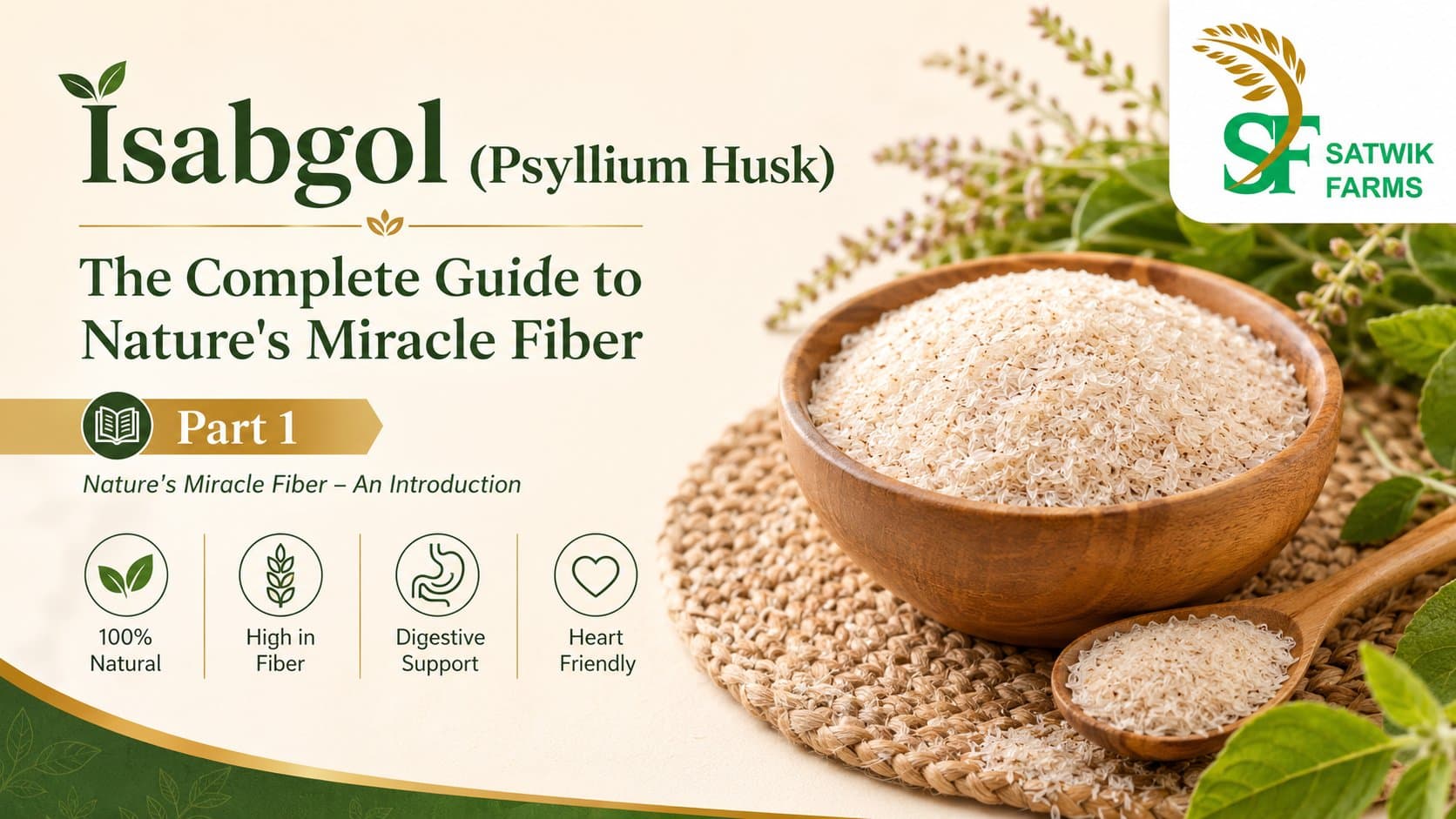
Digestive health is the foundation of overall well-being. Ayurveda teaches that nearly every disease begins with impaired digestion (Mandagni) and the accumulation of toxins (Ama), and modern science agrees that a healthy digestive system and balanced gut microbiome underpin metabolism, immunity, heart health and even mental well-being.
One humble natural food bridges that ancient wisdom and modern research better than almost any other: Isabgol, known worldwide as psyllium husk.
For generations, isabgol has been the household remedy for constipation. But decades of scientific study have shown its benefits reach much further — supporting blood sugar control, cholesterol management, weight management, gut health and cardiovascular wellness. Unlike chemical laxatives, it works in harmony with the body's own physiology: absorbing water, forming a soft gel, and gently normalising digestion.
This is Part 1 of our four-part isabgol guide. Continue with Part 2 — Health Benefits Backed by Science, Part 3 — Ayurvedic Wisdom & Traditional Uses and Part 4 — How to Use, Dosage & Precautions.
What Is Isabgol?
- Scientific name: Plantago ovata Forsk.
- Family: Plantaginaceae
- Common names: Isabgol (Hindi), psyllium husk, ispaghula husk, blond psyllium
Several Plantago species exist, but Plantago ovata is the one most widely cultivated for medicinal use because of its exceptionally high soluble fiber content. The name "isabgol" is believed to come from Persian words meaning "horse ear" — a nod to the shape of the seeds.
Botanical Description
Isabgol is a small annual herb (30–45 cm tall) that thrives in dry, semi-arid climates, with narrow lance-shaped leaves rising from the base and tiny white flowers packed into compact spikes. The seeds are small, oval and light brown — and their thin, translucent outer coating is where the value lies.
That coating, the husk, is rich in mucilage. During processing it is separated from the seed and cleaned. Mixed with water, the husk swells dramatically into a soothing gel — the source of virtually all of isabgol's health-promoting properties.
Origin: An Indian Success Story
The plant is native to the Mediterranean region and Western Asia, but over the centuries cultivation moved east, and today India produces most of the world's isabgol. The dry climate and sandy soils of Gujarat and Rajasthan are ideally suited to high-quality psyllium, and Indian isabgol is exported to more than 100 countries for use in pharmaceutical, nutraceutical and food products.
Nutritional Composition
Isabgol is unusual: its value lies not in vitamins or protein, but in an extraordinary concentration of fiber.
| Nutrient (per 100 g) | Amount (approx.) |
|---|---|
| Energy | ~180 kcal |
| Dietary fiber | 80–85 g |
| — of which soluble fiber | 70–75 g |
| Protein | 2–3 g |
| Fat | <1 g |
| Digestible carbohydrates | Very low |
| Sodium | Trace |
The dominant component is soluble mucilage — no other common food comes close to this soluble-fiber density.
What Makes Isabgol So Special?
Most people think of fiber as simply "roughage", but fiber comes in different forms with distinct functions. Isabgol is dominated by soluble, gel-forming fiber — the type with the strongest evidence for metabolic and digestive benefits.
On contact with water, the husk absorbs many times its own weight and forms a soft, viscous gel that:
- Softens hard stools and adds bulk
- Slows stomach emptying, promoting fullness
- Slows glucose absorption
- Binds bile acids, which may help reduce cholesterol
- Nourishes beneficial gut bacteria
- Supports regular bowel movements
This is why isabgol is useful in both constipation and mild loose stools — it normalises stool consistency rather than forcing the bowel in one direction.
How It Compares with Other Fiber Sources
| Feature | Isabgol | Chia Seeds | Flax Seeds | Oats | Wheat Bran |
|---|---|---|---|---|---|
| Main fiber type | Mostly soluble | Soluble + insoluble | Mixed | Soluble (beta-glucan) | Mostly insoluble |
| For constipation | ★★★★★ | ★★★★☆ | ★★★★☆ | ★★★☆☆ | ★★★★☆ |
| Blood sugar support | ★★★★★ | ★★★★☆ | ★★★★☆ | ★★★★★ | ★★★☆☆ |
| Cholesterol support | ★★★★★ | ★★★★☆ | ★★★★☆ | ★★★★★ | ★★★☆☆ |
| Satiety | ★★★★★ | ★★★★☆ | ★★★★☆ | ★★★★☆ | ★★★☆☆ |
| Protein | Very low | High | Moderate | Moderate | Moderate |
| Omega-3 fat | Negligible | High | Very high | Low | Low |
Takeaway: each fiber source has unique strengths — flax brings omega-3s, barley and oats bring beta-glucan — and a healthy diet combines them. Isabgol's niche is being the most concentrated soluble fiber of all.
How Isabgol Works Inside the Body
In the stomach: the husk absorbs water and expands, creating a gel that promotes fullness and slows the movement of food into the small intestine.
In the small intestine: the gel delays glucose absorption, softening post-meal blood sugar rises. It also binds some bile acids, nudging the body to use cholesterol to make more bile.
In the large intestine: retained water keeps stool soft, while gut bacteria ferment part of the fiber into short-chain fatty acids such as butyrate — the preferred fuel of the cells lining the colon. This gentle prebiotic effect supports a balanced gut microbiome.
Why Modern Diets Need This
Refined grains, sugary foods and ultra-processed products have pushed fiber intake well below recommended levels for most people. Low fiber intake is associated with constipation, obesity, type 2 diabetes, high cholesterol, heart disease, diverticular disease and poor gut-microbiome diversity.
Isabgol is an easy, natural way to close part of that gap — but it should complement, not replace, naturally fiber-rich foods: fruits, vegetables, legumes, sprouts, nuts, seeds and whole grains. That balance is the heart of the Satwik approach, and we return to it throughout this series.
Continue reading: Part 2 — Isabgol Health Benefits: Constipation, Blood Sugar, Cholesterol & Gut Health
This article is for general educational purposes only and is not a substitute for professional medical advice, diagnosis or treatment. If you have an existing medical condition, or are taking any medication, or are pregnant or breastfeeding, please consult your healthcare provider before adding fiber supplements to your diet.
Related Reading
Continue exploring the Satwik wellness collection: