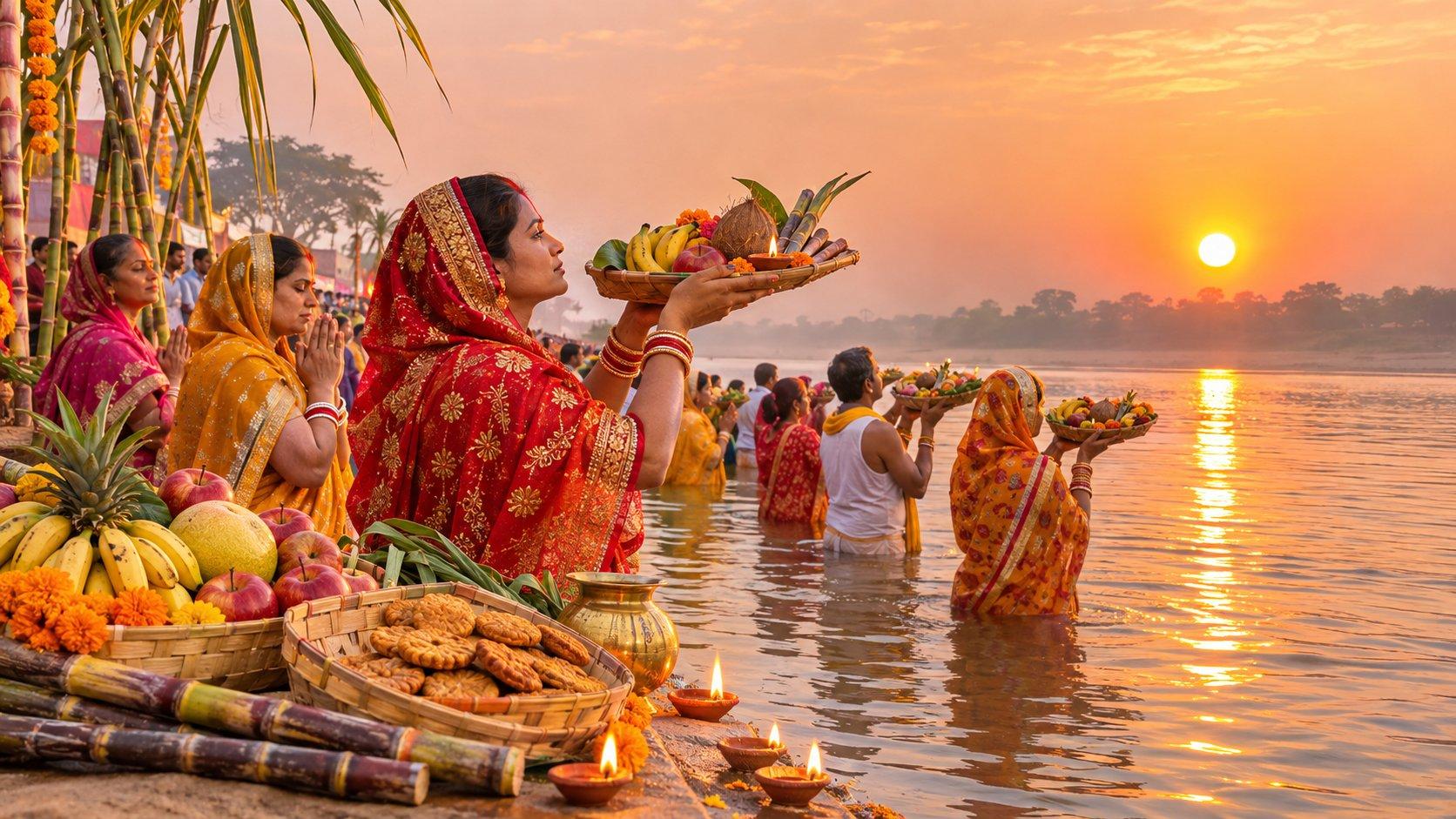
The great festival of devotion to Surya Dev and Chhathi Maiya
Chhath Puja is one of the most ancient Hindu festivals. It is dedicated to Surya Dev (the Sun God) and Chhathi Maiya, the divine mother who protects children and blesses families.
It is celebrated with extraordinary devotion in Bihar, Jharkhand, eastern Uttar Pradesh and the Terai region of Nepal — and today by families across India and around the world, wherever there is a river, a pond or a stretch of shore to stand in.
Chhath Puja is different from most Hindu festivals. There is no elaborate temple ritual and no idol at the centre of the worship. The prayers are offered in the open, beside water, to the setting Sun and then to the rising Sun, in gratitude for life, health and the harvest.
Chhath Puja 2026 Dates
In 2026, Chhath Puja falls from 13 to 16 November:
| Day | Ritual | Date |
|---|---|---|
| Day 1 | Nahay Khay | Friday, 13 November 2026 |
| Day 2 | Kharna | Saturday, 14 November 2026 |
| Day 3 | Sandhya Arghya (evening offering) | Sunday, 15 November 2026 |
| Day 4 | Usha Arghya and Parana | Monday, 16 November 2026 |
Sunset and sunrise times differ from place to place, so check your local panchang for the exact Arghya timings.
Why Is Chhath Puja Celebrated?
To thank Surya Dev, the source of life
The Sun gives light, warmth and energy to everything on Earth. In Hindu philosophy, Surya Dev is the visible form of divine energy — the one deity we can see every day. Without the Sun there would be no crops, no food and no seasons.
During Chhath, devotees thank Surya Dev for:
- Sustaining life and energy
- Ripening the crops that feed us
- Keeping the cycle of the seasons
- Blessing the family with health and prosperity
- Giving strength, wisdom and inner light
Chhath is therefore not only a festival of asking for blessings. It is a festival of gratitude towards the natural forces that keep us alive.
To worship Chhathi Maiya
Chhathi Maiya is worshipped as a divine mother. Devotees pray to her for the health and long life of their children, the well-being of the family, the blessing of a child for those who wish to become parents, and protection from hardship.
She is associated with Shashthi Devi, described in Hindu tradition as the protector of children. How Chhathi Maiya relates to Surya Dev varies from one regional tradition to another; in Chhath worship, both are revered together.
To give thanks for the harvest
Chhath comes just after the harvest season. The offerings are the produce of the land itself — sugarcane, bananas, coconut, seasonal fruit, new grain and jaggery — carried to the water's edge in bamboo baskets. This makes Chhath both a spiritual observance and a thanksgiving for nature's abundance.
The History of Chhath Puja: When Did It Start?
Chhath Puja has no single, universally accepted starting date. Its roots lie in ancient Indian Sun worship, Vedic tradition and regional folk practice that developed over many generations. It is hard to say exactly when the four-day festival took its present form — but scripture and traditional stories explain where it comes from.
The Vedic tradition of Sun worship
The Rigveda contains many hymns to the Sun and the solar deities. The best known of all Vedic mantras, the Gayatri Mantra, is addressed to Savitur, the divine solar power, and asks for the awakening of the intellect:
Om Bhur Bhuvah Svah Tat Savitur Varenyam Bhargo Devasya Dhimahi Dhiyo Yo Nah Prachodayat
Chhath Puja belongs to this long tradition of solar worship, even though the modern rituals cannot be dated precisely.
King Priyavrat and Chhathi Maiya
One traditional account of the festival's origin comes from the Brahmavaivarta Purana.
King Priyavrat and his wife, Queen Malini, had no child. They performed a yajna to ask for one. The queen conceived, but the child was stillborn, and the couple were overcome with grief.
At that moment a goddess appeared and introduced herself as Devasena, also called Shashthi Devi — born of the sixth part of Prakriti, with the power to bless people with children and protect them. She told the king and queen to worship her. They did so, and were in time blessed with a child.
From this story comes the practice of worshipping Shashthi Devi — Chhathi Maiya — for the protection and well-being of children.
Chhath Puja in the Ramayana and Mahabharata
Chhath is also linked with India's two great epics. Some of these details belong to regional tradition rather than to the texts themselves, but they are central to how the festival is understood.
- Lord Rama and Mata Sita — By popular tradition, after returning to Ayodhya from fourteen years of exile, Rama and Sita fasted and worshipped the Sun on Kartik Shukla Shashthi. Many see this as an early form of Chhath. In Munger, Bihar, a strong local tradition connects Mata Sita with Chhath worship.
- Karna, son of Surya Dev — Karna, the great warrior of the Mahabharata, was the son of Surya and Kunti and a devoted worshipper of his father. He is said to have stood in water each day to offer prayers to the Sun — the image most often connected with offering Arghya while standing in the river.
- Draupadi and the Pandavas — During their exile, Draupadi and the Pandavas are believed to have worshipped Surya Dev, who is associated with giving them the Akshaya Patra, the vessel that never ran out of food. Regional traditions connect Draupadi's Chhath vrat with the return of the Pandavas' fortunes.
Each story carries the same message: devotion to the Sun brings strength, nourishment and hope in difficult times.
Why Is It Celebrated on the Sixth Day?
The word Chhath comes from Shashthi, the Sanskrit word for "sixth". The main worship takes place on Kartik Shukla Shashthi — the sixth day of the bright fortnight of the lunar month of Kartik, six days after Diwali. Chhathi Maiya's link with Shashthi Devi gives the sixth day its second meaning.
How Is Chhath Puja Celebrated? The Four Sacred Days
The person who keeps the main fast is called the Vratin. Many Vratins are women, but men keep the Chhath vrat too.
Day 1: Nahay Khay — Purification
Nahay means to bathe and khay means to eat. The Vratin takes a ritual bath, the house and kitchen are cleaned thoroughly, and one simple sattvik meal is cooked and eaten after being offered to Surya Dev.
The traditional meal is rice, chana dal and bottle gourd (lauki or kaddu). Onion and garlic are avoided. The day prepares body, mind and home for the vrat.
Day 2: Kharna — The Fast Begins
The Vratin fasts through the day. After sunset, the Kharna prasad is prepared: rice kheer made with milk and jaggery, along with roti, often with a little ghee.
It is first offered to Chhathi Maiya and Surya Dev. The Vratin then eats it and shares it with family, relatives and neighbours.
After Kharna the stricter fast begins. In many families the Vratin takes neither food nor water until the morning Arghya on the fourth day — commonly called the 36-hour nirjala vrat, although practice differs between households. (A waterless fast is demanding. Anyone who is pregnant, elderly, or has a medical condition such as diabetes should speak to their doctor first, and may take part in the prayers without keeping the full fast.)
Day 3: Sandhya Arghya — Worship of the Setting Sun
This is the most beautiful and moving part of Chhath Puja. Families carry their offerings to a riverbank, pond, lake or community ghat in bamboo baskets called soop and daura.
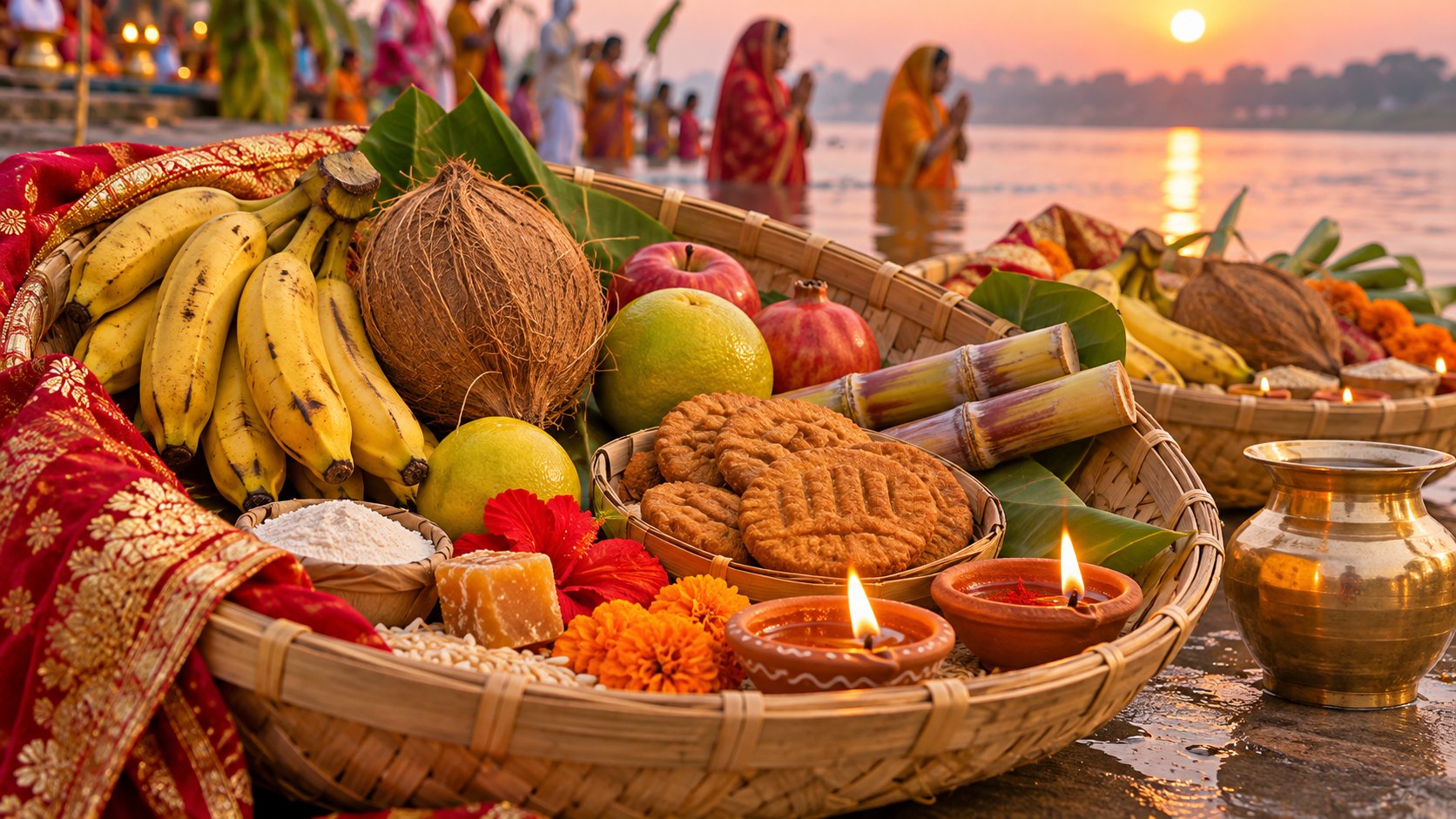
The baskets usually hold:
- Thekua — the signature Chhath sweet, made from wheat flour, jaggery and ghee
- Bananas, coconut and sugarcane
- Seasonal fruits and root vegetables, such as sweet potato
- Rice and other new-harvest grains
- Diyas and puja materials
As the Sun goes down, the Vratins stand in the water and offer Arghya — water poured from a vessel towards the Sun — while the family sings the traditional Chhath songs.
Why worship the setting Sun? In most traditions it is the rising Sun that is honoured. Chhath honours the setting Sun as well, in gratitude for the day that has passed, and as a reminder that endings are as sacred as beginnings.
Day 4: Usha Arghya — Worship of the Rising Sun
Before dawn on the final day, devotees return to the ghat and wait for the first rays. As Surya Dev rises above the horizon they offer the last Arghya, called Usha Arghya or Bihaniya Arghya. The rising Sun stands for hope, renewal, health and the continuation of life.
The Vratin then worships Chhathi Maiya and breaks the fast in a ritual called Parana. Prasad is shared with family, friends, neighbours and everyone at the ghat — the joyful end of Chhath Puja.
Why Is Chhath Puja Considered So Special?
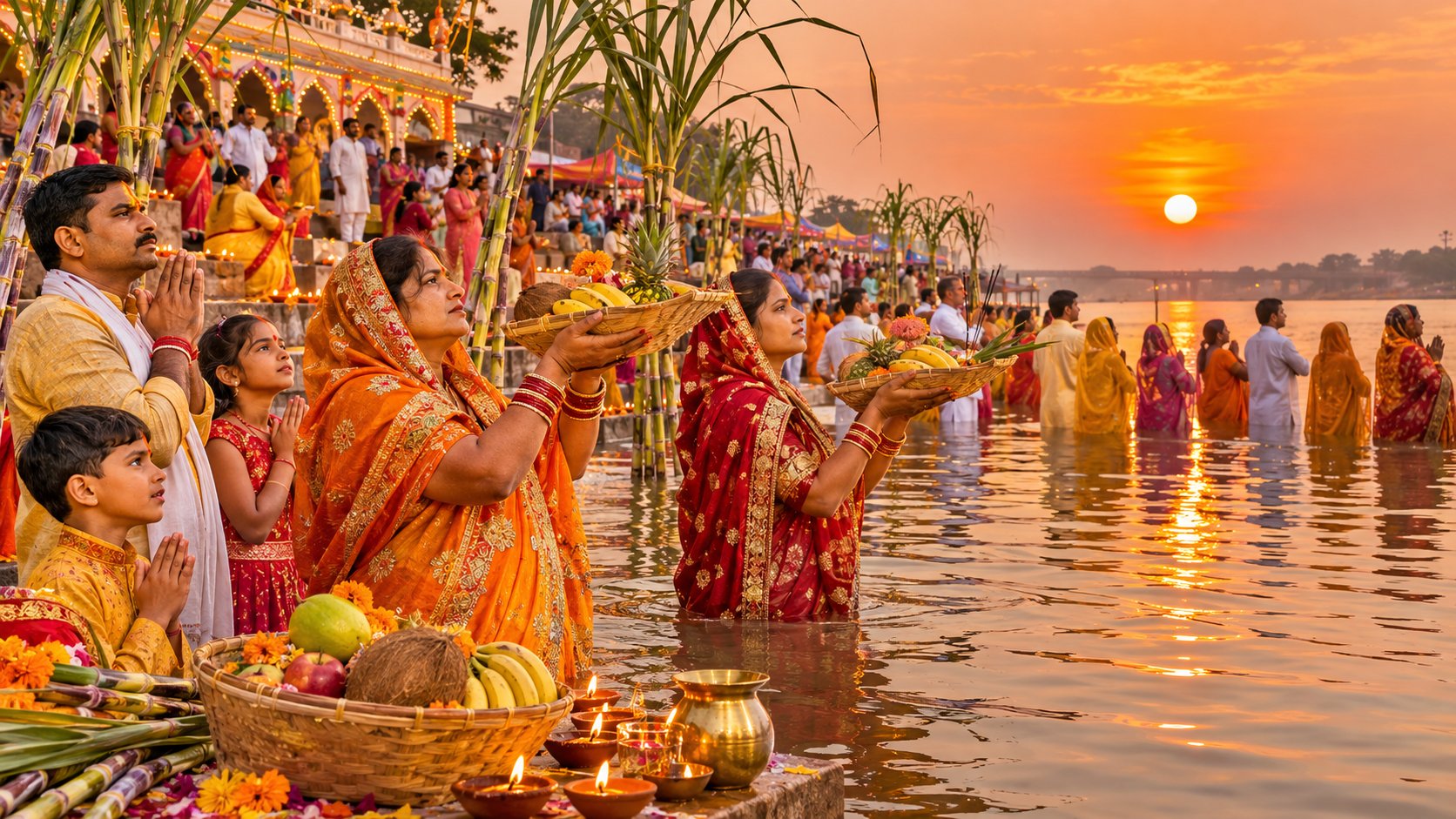
- The setting Sun is worshipped. It is among the very few major festivals in which the setting Sun is given such a place.
- No idol, no temple. The worship is offered directly to Surya Dev and Chhathi Maiya through nature.
- Strict purity and discipline. Cleanliness, simple food and personal devotion run through all four days.
- The whole family takes part. One person may keep the fast, but everyone prepares the prasad, arranges the offerings and cleans the ghat.
- Everyone stands as equals. At the ghat, people of every background stand side by side in the same water, praying to the same Sun and sharing the same prasad.
The Spiritual Message of Chhath Puja
Beyond the rituals, Chhath teaches that:
- Nature is sacred. The Sun, water, earth and food make our lives possible, and deserve respect and protection.
- Gratitude matters. We should notice what we have received rather than take it for granted.
- Discipline strengthens devotion. The vrat builds self-control and mental strength.
- Family is a blessing. The prayers to Chhathi Maiya are prayers of love for children and family.
- Every stage of life deserves respect. The setting Sun and the rising Sun are honoured equally.
- Sharing brings happiness. The prasad is always given away.
At Satwik Farms, where every crop depends on sunlight, clean water and healthy soil, this is a message close to our hearts. The foods of Chhath — jaggery, ghee, coconut, sugarcane, sweet potato and fresh fruit — are simple, seasonal and sattvik: food offered with thanks before it is eaten.
A Beautiful Way to Understand Chhath Puja
Chhath Puja is not simply a fast, or a ritual of offering water to the Sun. It is a celebration of the bond between people, nature and the divine.
The setting Sun reminds us to be grateful for everything we have received. The rising Sun reminds us to welcome the future with hope and faith. Chhathi Maiya is the loving, protective power of the divine mother.
That is why Chhath Puja is called a Mahaparv — a great festival of faith, purity, devotion and gratitude.
🙏 Jai Chhathi Maiya! ☀️ Jai Surya Narayan Bhagwan!
Related Reading
If you enjoyed this, you may also like:
- Akshaya Tritiya: Significance, Rituals & the Sacred Amla Tree
- Cow Ghee: The Golden Elixir of Ayurveda, Nutrition & Modern Wellness
- Chana Sattu: The Traditional Protein-Rich Superfood of Bihar
- Sweet Potato (Shakarkand): Nutrition, Ayurvedic View & Benefits
- How to Charge Water for Positive Energy: A Simple Daily Ritual