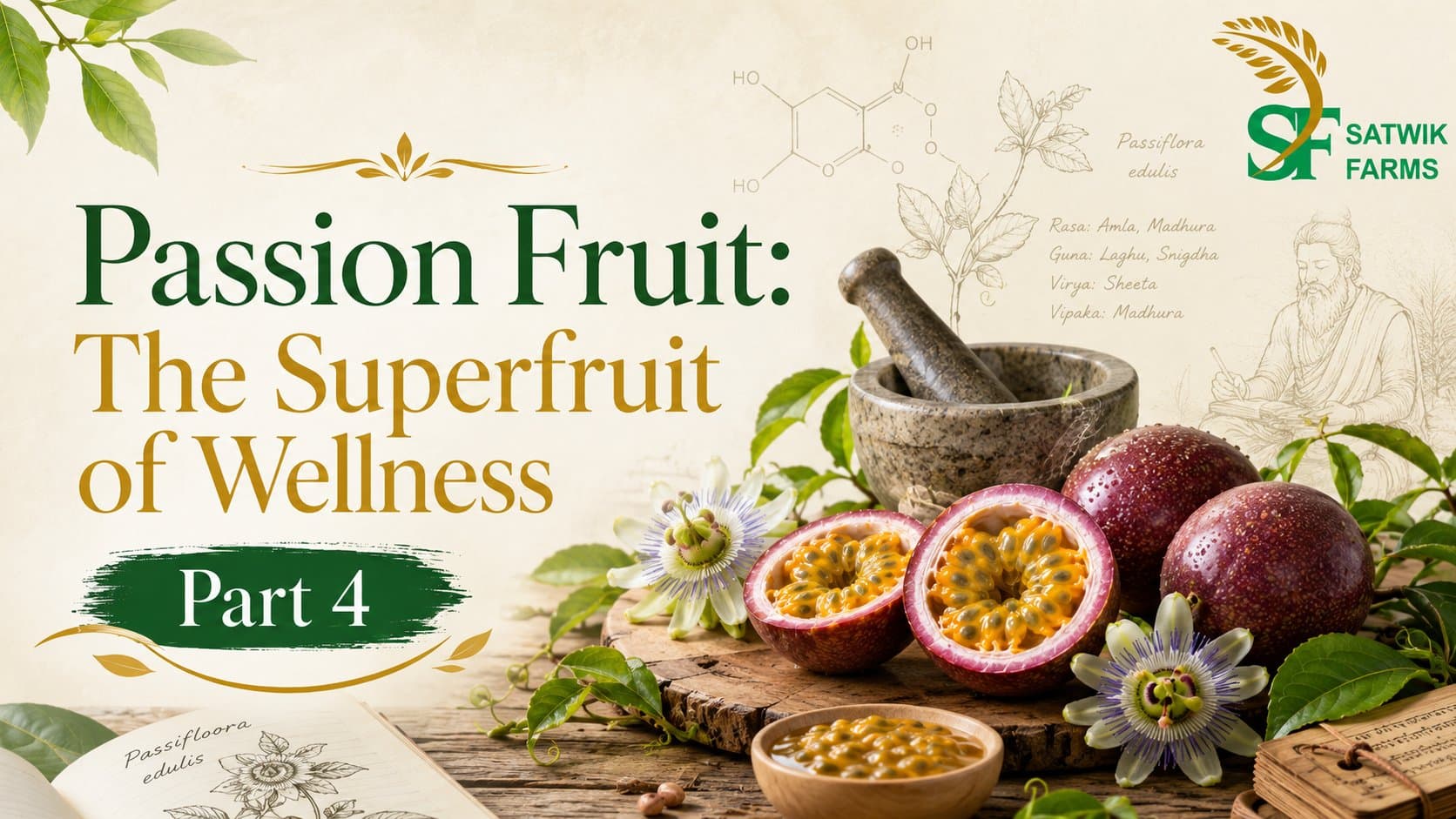
In the first three parts of this guide we covered passion fruit's nutrition, health benefits and how to eat it. In this final part, we look at the fruit through the older lens of Ayurveda and the Satwik way of living — and close the series with myths, a scientific summary and our recommendations.
This is Part 4 (final) of our passion fruit guide. Also read Part 1 — Nutrition & Botany, Part 2 — Health Benefits and Part 3 — How to Eat It.
Passion Fruit in Ayurveda
Passion fruit is not described in the classical Ayurvedic texts — it is native to South America and reached the Indian subcontinent much later. But Ayurveda has never been limited to a fixed list of foods: it evaluates any food through its Rasa (taste), Guna (qualities), Virya (potency) and Vipaka (post-digestive effect), and its influence on the three Doshas — Vata, Pitta and Kapha.
Applying these principles, passion fruit's approximate Ayurvedic profile looks like this:
| Property | Description |
|---|---|
| Rasa (taste) | Madhura (sweet), Amla (sour) |
| Guna (qualities) | Laghu (light), Snigdha (slightly unctuous, owing to the seeds) |
| Virya (potency) | Generally Shita (cooling) |
| Vipaka (post-digestive effect) | Madhura (sweet) |
| Dosha effect | Balances Pitta; mildly pacifies Vata when ripe; may increase Kapha if eaten in excess |
Ripeness matters. Fully ripe passion fruit is sweeter and gentler on digestion; unripe fruit is more acidic and sharper. As with most fruits, the Ayurvedic effect shifts with how ripe the fruit is when you eat it.
Passion Fruit and Digestive Fire (Agni)
Ayurveda places great importance on Agni — the digestive and metabolic fire that transforms food into energy and tissue. A healthy Agni supports digestion, nutrient absorption, immunity and mental clarity.
Because passion fruit is light (Laghu) and fiber-rich, it generally supports digestion when eaten in moderation. Two practical cautions from the Ayurvedic view:
- People with weak digestion should avoid large quantities at once.
- Avoid eating it immediately after a heavy meal — fruit is best enjoyed on its own or as part of a lighter meal.
From the Ayurvedic perspective on diabetes (Madhumeha) — understood as an imbalance of Kapha and Meda (fat tissue) with impaired metabolism — fresh fruit in moderate portions can be part of a balanced diet, matched to the individual's constitution and blood sugar control, alongside proper medical treatment.
Passion Fruit as a Satwik Food
Ayurvedic and Yogic philosophy classifies foods as Satwik, Rajasic or Tamasic. Satwik foods are fresh, naturally ripened, seasonal, pure, easily digestible and rich in Prana (life energy).
Fresh, ripe passion fruit meets these qualities well: natural sweetness, refreshing hydration, antioxidants and vitality without heaviness. To enjoy it the Satwik way:
- Choose fresh, naturally ripened, preferably local and seasonal fruit.
- Wash thoroughly and eat it freshly cut.
- Eat slowly and mindfully, without refined sugar.
- Pair it with wholesome foods — sprouts, homemade yogurt, nuts or seeds.
- Prefer the whole fruit over processed juices and sweetened beverages.
- Practise moderation — even healthy foods can be overeaten.
Ayurveda reminds us that the right food, in the right quantity, at the right time is more beneficial than any single "miracle" food. A Satwik lifestyle is not defined by one superfruit but by purity, balance, moderation, gratitude and mindful eating.
Passion Fruit and Sustainable Farming
Passion fruit vines thrive in tropical and subtropical climates, and when cultivated responsibly they fit beautifully into sustainable farming systems:
- Their spectacular flowers attract bees and pollinators, supporting biodiversity.
- As climbers, they make efficient use of vertical growing space.
- They integrate well into mixed farming systems and give small farmers an additional income stream.
- Locally grown vines mean fresher, seasonal fruit with fewer food miles.
At Satwik Farms, we believe healthy soil, clean water and minimal chemical use are the foundation of nutritious food — the same regenerative principles we apply across the farm. Fruit grown in harmony with nature simply tastes better, and it protects the land for the next generation.
Who Can Benefit Most from Passion Fruit?
Regular, moderate consumption may be particularly helpful for:
- People whose diets are low in fiber
- Anyone looking to support digestive health
- Those focused on heart health
- People seeking natural sources of vitamin C and antioxidants
- Those using high-fiber foods for weight management
- Anyone following a whole-food, plant-rich eating pattern
Myth vs Fact
Myth: Passion fruit cures diabetes. Fact: It does not. Its fiber-rich pulp can be part of a diabetes-friendly eating pattern in appropriate portions — alongside, never instead of, medical treatment and lifestyle measures.
Myth: You shouldn't eat passion fruit because of the seeds. Fact: The seeds are edible and contribute fiber and beneficial plant compounds. Most people can eat them safely.
Myth: More passion fruit means better health. Fact: Health comes from an overall balanced diet. Excessive amounts of any one food can cause digestive discomfort or excess calorie intake.
Myth: Passion fruit juice is as healthy as the whole fruit. Fact: The whole fruit is generally better — strained juice loses much of the valuable fiber.
Scientific Summary
Bringing the whole series together, current evidence suggests that passion fruit:
- Is an excellent source of dietary fiber
- Provides significant vitamin C and vitamin A precursors
- Contains antioxidant polyphenols and carotenoids
- Supports digestive health through its fiber
- May contribute to heart health as part of an overall healthy diet
- Can fit into balanced meal plans for people with diabetes, with attention to portions
- Supplies nutrients that support immunity, skin and eye health
Many of the more specific findings come from laboratory and animal studies, while human research is still developing. Passion fruit is best seen as a nutritious food that supports health — not a medicine that treats disease.
The Satwik Farms Recommendation
Our approach to nutrition is deliberately simple:
- ✔ Eat fresh, seasonal fruits — variety over any single "superfood"
- ✔ Fill your plate with colourful, minimally processed plant foods
- ✔ Combine fruits with protein-rich foods — sprouts, tofu, yogurt or nuts
- ✔ Stay physically active and sleep well
- ✔ Practise gratitude and mindful eating
Passion fruit fits this philosophy beautifully: vibrant flavour, valuable nutrients and natural vitality beneath a modest shell. When we choose fresh, natural, minimally processed foods, we nourish not only our bodies but also our minds and our connection with the natural world.
This article is for general educational purposes only and is not a substitute for professional medical advice, diagnosis or treatment. If you have an existing medical condition (especially diabetes), or are taking any medication, or are pregnant or breastfeeding, please consult your healthcare provider before making significant changes to your diet.
Related Reading
If you enjoyed this series, continue exploring: