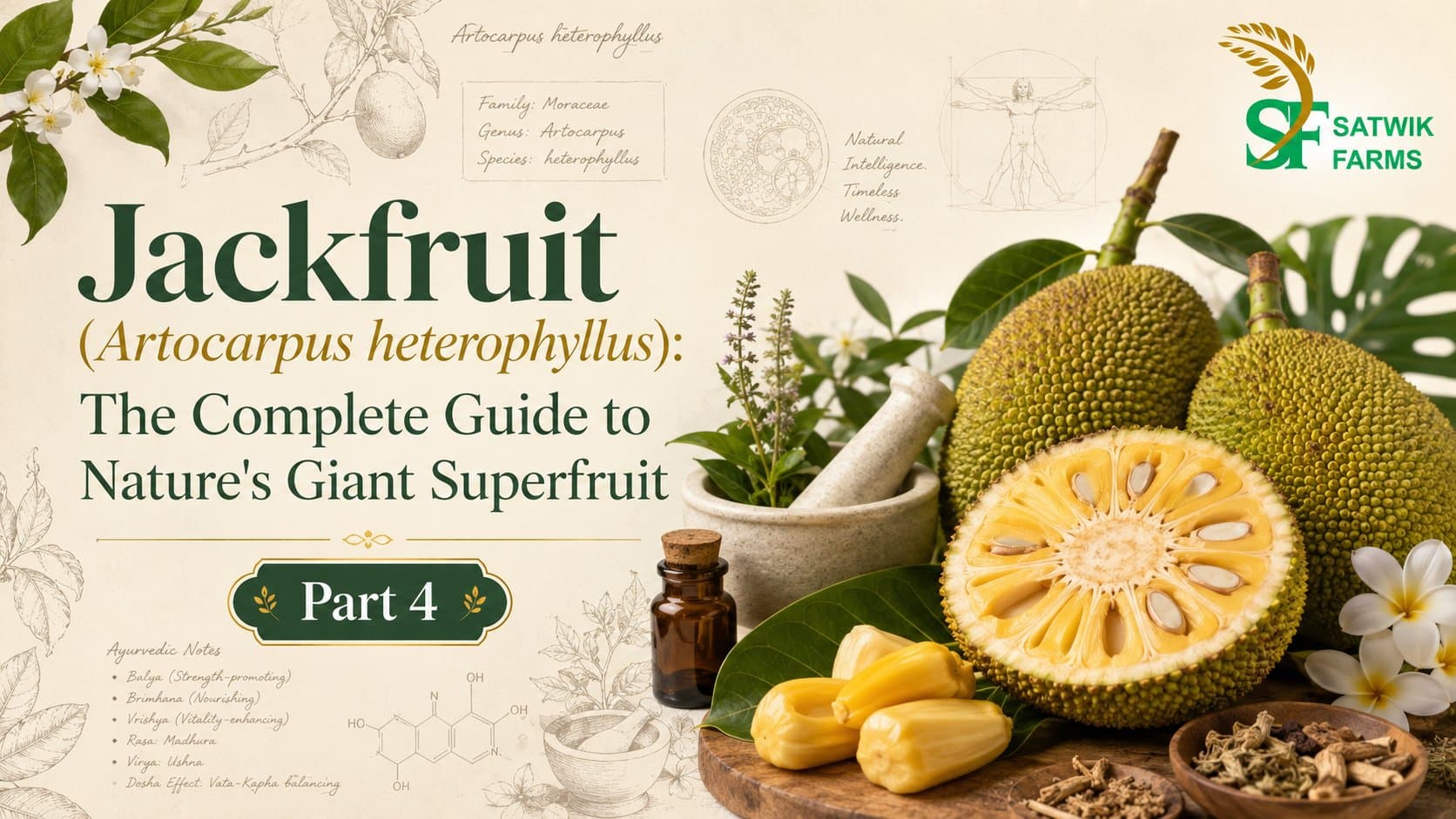
In the first three parts we covered jackfruit's nutrition, health benefits and how to eat it. In this final part we turn to the older lens: how Ayurveda understands this giant fruit, and how it fits a Satwik way of living.
This is Part 4 (final) of our jackfruit guide. Also read Part 1 — Nutrition & Raw vs Ripe, Part 2 — Health Benefits and Part 3 — How to Eat It.
Jackfruit in Ayurveda
Unlike many "new" superfoods, jackfruit (known in Sanskrit as Panasa) has been part of Ayurvedic practice for centuries. Ayurveda recognises that the raw fruit, ripe fruit, seeds, leaves and bark all have different qualities and applications — and rather than labelling jackfruit simply "good" or "bad", it asks the more useful question: for whom, in what form, in what season, and how much?
Eaten appropriately, jackfruit is regarded as deeply nourishing — traditionally described as Balya (strength-promoting) and Brimhana (building and nourishing to the tissues). Eaten to excess, especially with weak digestion, it can feel heavy and cause gas.
Ayurvedic Properties of Jackfruit
| Property | Description |
|---|---|
| Rasa (taste) | Madhura (sweet), predominant in ripe fruit; slight Kashaya (astringent) in raw fruit and seeds |
| Guna (qualities) | Guru (heavy), Snigdha (unctuous), mildly Picchila (soft, moist) |
| Virya (potency) | Generally Shita (cooling) |
| Vipaka (post-digestive effect) | Madhura (sweet) — nourishing and strengthening when digestion is efficient |
The sweet taste nourishes body tissues and provides sustained energy; the astringent note in the raw fruit supports digestion and tissue repair. Because jackfruit is heavy and unctuous, it is filling and building — and best taken in moderation by anyone with sluggish digestion.
Effect on the Doshas
- Vata: ripe jackfruit, eaten in moderation, can help calm aggravated Vata. Raw fruit and seeds may increase gas if digestion is weak.
- Pitta: its cooling nature makes ripe jackfruit generally pacifying for excess Pitta — particularly refreshing in hot weather.
- Kapha: the sweetness and heaviness mean excess can aggravate Kapha. Kapha-predominant individuals should keep portions moderate and combine jackfruit with digestive spices such as ginger or black pepper.
Jackfruit and Agni (Digestive Fire)
Digestive wellness is central to Ayurveda, and jackfruit is a classic example of a food whose effect depends on Agni. With strong digestion, it builds strength and tissue; with weak digestion, the same fruit produces heaviness. The traditional guidance matches what we covered practically in Part 3: moderate portions, thorough chewing, warming spices, and respect for your own capacity.
On diabetes, Ayurveda's view of Madhumeha focuses on digestion, metabolism and dosha balance rather than sugar content alone — raw jackfruit prepared with cumin, ginger and black pepper is traditionally easier to place in a balanced diet than large quantities of the ripe fruit, which aligns neatly with the modern evidence in Part 2.
Jackfruit in a Satwik Lifestyle
A Satwik diet emphasises foods that are fresh, seasonal, naturally ripened, minimally processed and close to their natural state. Jackfruit fits this philosophy remarkably well:
- Naturally sweet without any refined sugar
- Seasonal and locally abundant across the tropics
- Rich in fibre and micronutrients
- Free from artificial additives when eaten fresh
- A pillar of plant-based cooking
- An invitation to mindful eating and moderation — one fruit, shared
Fresh, tree-ripened jackfruit is always preferable to canned products, which often carry added sugar, salt or preservatives.
The Low-Waste Fruit: Jackfruit and Sustainability
Jackfruit embodies sustainable, low-waste eating better than almost any food we grow:
- One tree yields enormous quantities of food for decades — often more than 100 years — with minimal agricultural inputs.
- Bulbs are eaten ripe, the raw fruit becomes a vegetable, the seeds a protein-rich food, the leaves cattle feed, and the wood prized timber.
- As a canopy tree it shades mixed plantings and supports biodiverse, regenerative farming systems — the approach we follow at Satwik Farms.
Choosing fresh, locally grown jackfruit and preparing it with simple ingredients preserves both its nutrition and its flavour — and honours a tree that traditional India rightly called the "tree of abundance".
Key Takeaways from the Series
- Raw and ripe jackfruit are different foods. Raw is a fibrous, low-sugar, resistant-starch-rich vegetable; ripe is a sweet, cooling, energy-giving fruit.
- The seeds are a superfood in their own right — cook them, don't discard them.
- Modern evidence is encouraging for blood sugar (raw fruit replacing refined carbs), heart health, digestion and gut health — but jackfruit is a nutritious food, not a medicine.
- Ayurveda matches the fruit to the person: nourishing and strength-promoting when portioned to your digestion, constitution and season.
- A Satwik approach favours fresh, seasonal, naturally ripened jackfruit eaten mindfully and in moderation.
Jackfruit is far more than a delicious tropical giant. It is a versatile, nutrient-rich food that has nourished communities for millennia — a beautiful example of traditional wisdom and modern nutrition science pointing in the same direction. At Satwik Farms, we encourage you to embrace nature's seasonal abundance, one golden bulb at a time.
This article is for general educational purposes only and is not a substitute for professional medical advice, diagnosis or treatment. If you have an existing medical condition (especially diabetes or kidney disease), or are taking any medication, or are pregnant or breastfeeding, please consult your healthcare provider before making significant changes to your diet.
Related Reading
If you enjoyed this series, continue exploring: