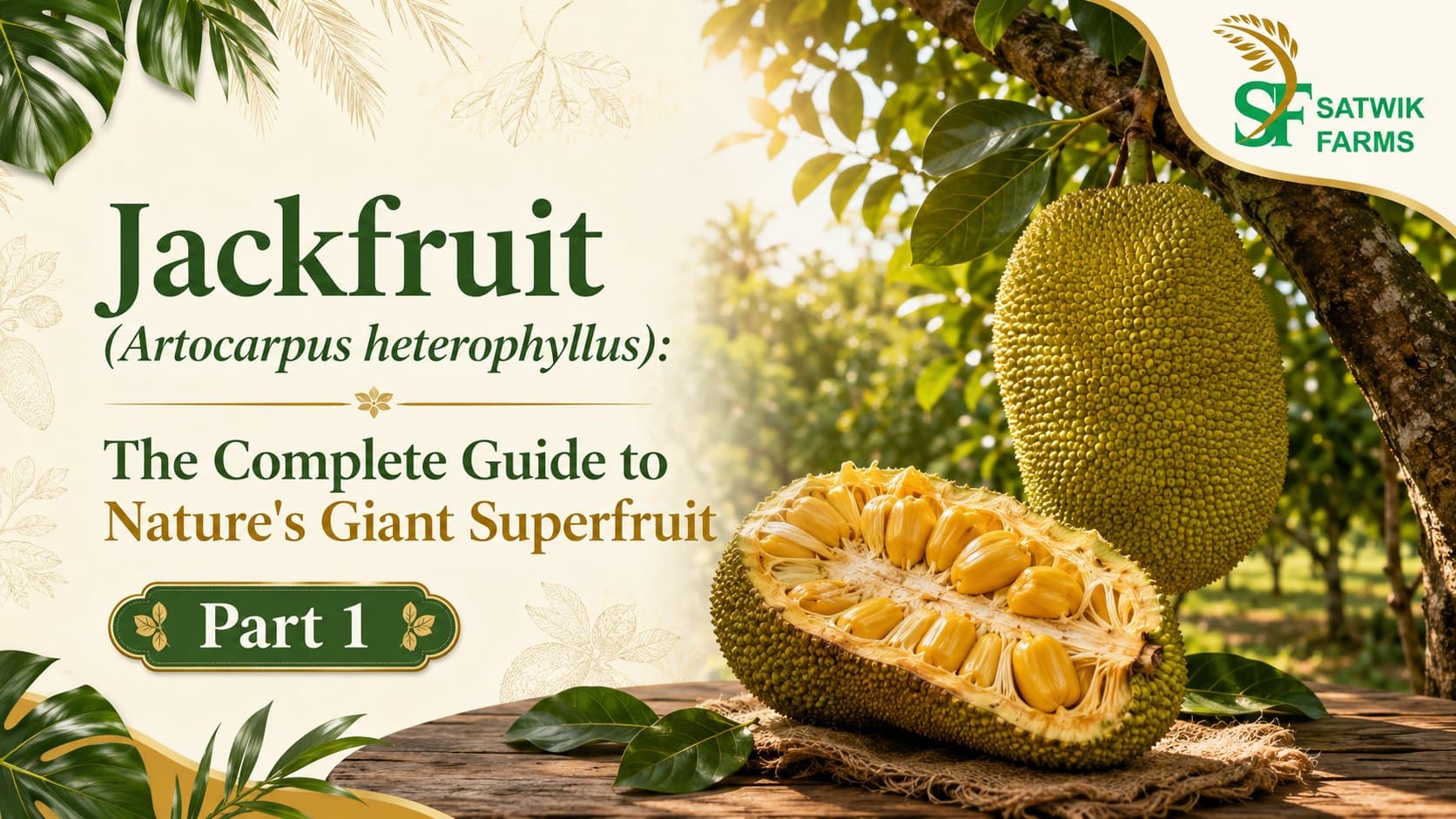
Jackfruit is one of nature's most extraordinary gifts. Famous for its enormous size, sweet aroma and remarkable nutritional richness, it has nourished tropical communities for thousands of years. Every part of the tree — fruit, seeds, leaves, bark, latex, even the wood — has traditionally been used for food, medicine or livelihood.
In recent years jackfruit has gone global, and for good reason. The raw (green) fruit has become a popular plant-based meat alternative thanks to its fibrous texture, while the ripe fruit is loved for its naturally sweet golden bulbs packed with vitamins, minerals, antioxidants and fibre.
At Satwik Farms, we see jackfruit as a perfect example of seasonal abundance: one fruit can feed a family, and almost nothing goes to waste.
This is Part 1 of our four-part jackfruit guide. Continue with Part 2 — Health Benefits, Part 3 — How to Eat It and Part 4 — Ayurveda & Satwik Living.
What Is Jackfruit?
- Scientific name: Artocarpus heterophyllus Lam.
- Family: Moraceae (the mulberry family)
- Claim to fame: the largest edible fruit produced on any tree in the world
Botanical Description
Jackfruit grows on a large evergreen tropical tree, typically 10–25 metres tall, with a dense canopy of thick, glossy, dark-green leaves. The trees are long-lived — often more than 100 years — and carry separate male and female flowers on the same tree.
The fruit itself is a compound multiple fruit, usually weighing 5–20 kg, with exceptional specimens exceeding 40 kg. Unlike most fruits, jackfruit grows directly from the trunk and large branches — a phenomenon botanists call cauliflory.
Origin and History
Jackfruit originated in the tropical rainforests of the Western Ghats of India and has been cultivated for more than 3,000 years. From there it spread across Bangladesh, Sri Lanka, Nepal, Myanmar, Thailand, Indonesia, Malaysia and the Philippines, and onward to East Africa (including Tanzania), Brazil, the Caribbean and Central America.
Today India remains one of the largest producers, followed by Bangladesh and several Southeast Asian countries.
Why Is Jackfruit Called the "Poor Man's Fruit"?
Traditionally, jackfruit earned this name because one fruit can feed an entire family, nearly every part is edible, and the tree grows abundantly with minimal agricultural inputs — delivering carbohydrates, vitamins, minerals, fibre and protein-rich seeds at very low cost. In many parts of India it is also known as the "tree of abundance", filling kitchens with curries, pickles, chips and festive sweets.
Ironically, jackfruit has now become a premium health food in many Western countries.
The Different Parts of Jackfruit — and How They're Used
| Part | Traditional & Modern Uses |
|---|---|
| Ripe bulbs | Eaten fresh; rich in vitamin C and antioxidants |
| Raw (green) fruit | Cooked as a vegetable; popular vegan meat alternative |
| Seeds | Boiled, roasted or curried; rich in protein and resistant starch |
| Leaves | Traditional cattle feed; studied for potential antidiabetic properties |
| Bark & latex | Used in traditional medicine (only under expert guidance) |
| Wood | Durable timber for furniture and musical instruments |
Nutritional Value of Ripe Jackfruit (Per 100 g Edible Portion)
| Nutrient | Amount (approx.) |
|---|---|
| Energy | ~95 kcal |
| Carbohydrates | ~23.5 g |
| Natural sugars | ~19 g |
| Dietary fibre | ~1.5–3 g |
| Protein | ~1.7 g |
| Fat | ~0.6 g |
| Vitamin C | ~13–14 mg |
| Potassium | ~448 mg |
| Magnesium | ~29 mg |
| Calcium | ~24 mg |
| Phosphorus | ~21 mg |
| Iron | ~0.2–0.3 mg |
Ripe jackfruit also provides small amounts of vitamin A and folate, and is naturally cholesterol-free and very low in fat.
Key phytochemicals: flavonoids, carotenoids (including lutein and zeaxanthin), lignans, isoflavones, phenolic acids, tannins and saponins — compounds studied for their antioxidant and anti-inflammatory properties.
Raw (Green) Jackfruit Is a Different Food Altogether
Nutritionally, green jackfruit differs considerably from the ripe fruit. It contains less sugar, fewer calories, more resistant starch and more fibre, producing a noticeably lower glycaemic response.
| Feature | Raw Jackfruit | Ripe Jackfruit |
|---|---|---|
| Taste | Neutral | Sweet |
| Texture | Fibrous, "meaty" | Soft and juicy |
| Sugar | Low | High |
| Fibre | Higher | Moderate |
| Resistant starch | High | Low |
| Glycaemic response | Lower | Moderate |
| Used as | Vegetable | Fruit |
| Best suited for | Blood-sugar-conscious diets, weight management, vegan cooking | Children, athletes, quick natural energy, seasonal snacking |
Which is healthier? Neither — they serve different purposes. Raw jackfruit shines in savoury, high-fibre meals; ripe jackfruit is a wholesome natural sweet. We compare them condition-by-condition in Part 2.
Jackfruit Seeds: An Overlooked Superfood
Many people discard the seeds, yet they are one of the most nutritious parts of the fruit, providing plant protein, resistant starch, fibre, iron, potassium, magnesium and B vitamins. Boiled or roasted, they become pleasantly nutty and easier to digest — perfect in soups and curries, as a snack, or ground into flour to mix with other flours.
Why Jackfruit Is Winning Worldwide
Health experts and food scientists keep returning to jackfruit because it is naturally gluten-free, cholesterol-free and low in fat, rich in antioxidants and potassium, a good source of fibre, sustainable to cultivate, and an excellent plant-based alternative in savoury cooking — all while being genuinely delicious.
Continue reading: Part 2 — Jackfruit Health Benefits: Diabetes, Weight, Heart & Gut Health
This article is for general educational purposes only and is not a substitute for professional medical advice, diagnosis or treatment. If you have an existing medical condition, or are taking any medication, or are pregnant or breastfeeding, please consult your healthcare provider before making significant changes to your diet.
Related Reading
Continue exploring the Satwik wellness collection:
- Passion Fruit: The Superfruit of Wellness — Nutrition, Botany & Antioxidant Power
- Papaya Benefits: Nutrition, Digestion & the Ayurvedic View
- Tofu: Benefits, Nutrition, Ayurveda & How Much to Eat Daily
- Microgreens: A Satwik Superfood Backed by Science & Ayurveda
- Why Choose Satwik Farms: Regenerative, Residue-Free Farming for a Better Future